Typewriter Maintenance & Care Guide

Workshop guide · El Granero · Est. 2013

Keep your typewriter healthy.

A vintage typewriter usually needs less intervention than people think. Keep it clean, covered, dry and moving; use the right ribbon and paper; and never force a mechanism that has begun to resist.

Vintage workshop illustration used for the El Granero Typewriter Maintenance Guide
El Granero Typewriter Company TYPEWRITER CARE Est. 2013 · Type What You Love

Start here

The small habits that matter most.

Most damage we see does not come from normal typing. It comes from forcing something that is stuck, using the wrong cleaner or lubricant, storing the machine in damp conditions, or letting dust and old oil build up for years.

Golden rule: clean first, lubricate only when genuinely needed, and stop when a mechanism resists. A manual typewriter should feel mechanical — not forced.

01

Use paper

Never strike the type directly onto a bare platen. On older hard platens, two sheets can add useful cushioning.

02

Return gently

Use the carriage return lever normally. If you need to reposition the carriage by hand, use the carriage-release control.

03

Keep it dry

Tea, coffee, humidity and damp storage are far more dangerous than ordinary use.

04

Brush the dust

A soft brush and a clean cloth prevent debris from becoming a sticky mixture inside the mechanism.

05

Cover it

After use, protect the machine with its case or a breathable, well-fitting dust cover once the machine is dry.

06

Never force it

A jammed carriage, key, lever or knob is a diagnostic clue. More force is rarely the repair.

Everyday handling

Use it. Typewriters like to move.

Regular, normal use helps you notice changes early: a key that starts to return slowly, a carriage that feels heavier, a ribbon that is drying out.

Restored Olivetti Pluma 22 from the El Granero workshop
A restored machine should be enjoyed, not kept frozen as an object. Gentle regular use is part of good care.

During a typing session

  • Keep drinks and crumbs away from the keyboard and segment.
  • Do not hammer keys harder to compensate for a dry ribbon.
  • If two typebars collide, release them gently rather than pulling sideways.
  • Do not push the carriage against the escapement; use the carriage release when repositioning it manually.

When you finish

  • Remove paper if the machine will sit unused for a long period.
  • Brush away eraser crumbs and visible dust.
  • Return controls to a sensible neutral position and follow your case-lock instructions before transport.
  • Cover or case the machine only when it is clean and dry.

Cleaning

Clean without turning maintenance into restoration.

For normal home care, start dry and gentle. A soft brush, clean microfiber cloth and patience solve more than aggressive chemicals do.

Body & keys

Use a soft dry cloth, or a barely damp cloth where appropriate. Never soak key legends, seams or openings.

Type slugs

Brush compacted ink and paper fibre carefully. Work slowly so you do not bend typebars or scratch nearby finishes.

Inside

Use a soft brush first. If you use air, keep it low-pressure and controlled so debris is not blasted deeper into the machine.

Avoid: WD-40, silicone sprays, penetrating oils, aerosol “all-purpose” lubricants, acetone and strong cleaners on painted or plastic surfaces. Vintage finishes vary enormously and can react quickly.

Original Olympia wooden typewriter cleaning brush from El Granero

Ribbon, paper & platen

Give the striking system something kind to work against.

A faint impression is often a ribbon problem, not a reason to hit the keys harder. The platen and feed rollers are also consumable rubber parts: age can make them hard, shiny or uneven even when the rest of the machine is excellent.

Fresh ribbon

Replace a dry or exhausted ribbon and make sure it is threaded through the vibrator correctly. Keep original metal spools when a model requires them and rewind fresh ribbon onto them if necessary.

Paper

Use normal writing paper. With an older hard platen, a second backing sheet is a simple way to soften the strike and protect the typing system.

Platen & rollers

For ordinary surface dirt, wipe with a lightly damp cloth and a trace of mild soap, rotating the platen by hand. Do not soak rubber or attack it with harsh solvents.

Lubrication

Less is more.

A typewriter is not something to oil on a calendar. Excess lubricant attracts dust, migrates into places where it does not belong and can eventually become the very reason a machine feels sticky.

What we recommend

  • Clean first and identify the exact friction point before adding anything.
  • Use only a tiny amount of appropriate fine machine lubricant on a specific metal pivot or rail when it is actually required.
  • Wipe away excess immediately.

What to keep dry

  • The segment should normally remain clean and dry; sluggish typebars often indicate dirt or old residue, not a shortage of oil.
  • Keep lubricant away from the ribbon, platen, feed rollers, belts, rubber parts and paper path.
  • If you see old hardened grease or a mechanism is still stiff after cleaning, stop adding oil and service the cause.

If you are unsure where the friction is coming from, send us a short video before experimenting. A five-minute diagnosis can prevent a much larger repair.

El Granero dust cover emblem showing a vintage typewriter protected under a cover

Storage

Dust, damp and direct sun are the real long-term enemies.

  • Choose a stable indoor room rather than a damp basement, hot attic, garage or balcony.
  • Keep the machine away from direct sun and radiators; heat ages rubber, plastics and finishes.
  • Use a fitted cover or original case to slow dust accumulation.
  • Do not seal a damp machine into a case. Let it dry fully first.
  • For very long storage, remove paper and follow the original manual for carriage locks, paper-release settings and transport controls.
  • Take the machine out occasionally and type a page. Normal movement is healthier than years of complete inactivity.
Rare vintage typewriter parts from the El Granero workshop

Know when to stop

Some problems belong on the workbench.

Stop DIY maintenance when the carriage will not advance, the drawband has failed, the machine grinds or skips repeatedly, a lever is bent, the mainspring has lost tension, the paper feed no longer grips, or a part has cracked or come loose.

Those symptoms usually need diagnosis, adjustment or parts — not more force and not more oil.

Rare and pre-war machines: treat them individually. Fragile castings, uncommon mechanisms, hard-to-find parts and original finishes may need model-specific care. If the listing or manual gives special instructions, those take priority over this general guide.

Care essentials

A few useful things. No giant toolbox required.

These are examples from our product and content galleries. The exact ribbon, spool or brush depends on the machine, so check the model before ordering.

Fresh typewriter ink ribbon from El Granero

Fresh ribbon

A fresh ribbon gives a darker impression without forcing the keys. Match the ribbon and spool system to your model.

Browse ribbons
Custom transparent dust cover for a vintage typewriter from El Granero

Dust cover

Probably the easiest long-term maintenance tool: keep everyday dust off the keyboard, segment and carriage.

See a custom cover
Vintage wooden typewriter cleaning brush from El Granero

Soft cleaning brush

A controlled brush is more useful for routine care than aggressive sprays or chemicals.

See this brush

Quick FAQ

The questions we hear most often.

Short answers for everyday ownership. If your machine behaves differently from normal, a model-specific manual or workshop diagnosis is the better next step.

Should I oil my typewriter regularly?

No. Oil only a specific friction point when there is a reason to do so. Routine over-oiling is one of the most common causes of sticky, dirty mechanisms.

Can I use WD-40 or a general-purpose spray?

Not as routine typewriter maintenance. Sprays migrate, attract dirt and are difficult to control around rubber, paint, the escapement and the segment.

Why are my keys becoming slow or sticky?

Very often the cause is dust mixed with old residue in the segment or pivots. Clean first. Adding more oil without diagnosing the cause can make the problem worse.

Should I leave paper in the machine?

For a machine you use every day, a sheet for a short period is not a crisis. For long-term storage, remove it and keep the paper path clean and relaxed according to the original manual.

Is one sheet of paper enough?

Usually yes, but a second backing sheet is a simple and useful cushion on older machines with a hard platen. Never type directly onto the bare platen.

How often does a typewriter need professional service?

There is no universal calendar. A daily-use machine and a machine used for occasional letters live very different lives. Service it when the action changes, when old grease or corrosion is present, after impact or transport damage, or when adjustments and parts are involved.

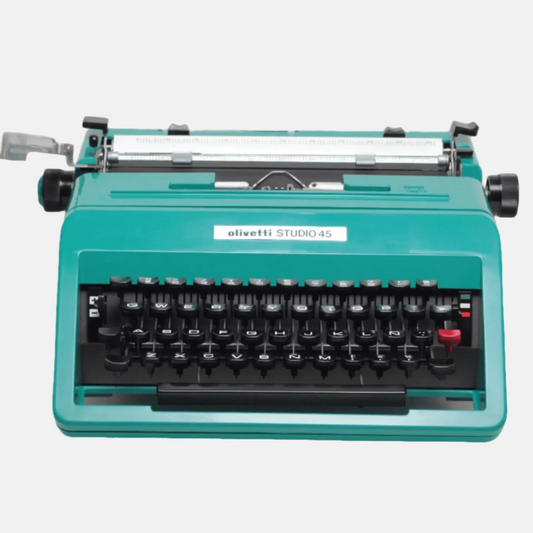
Explore Olivetti Best Sellers

Latest Review

"I had a wonderful experience with El Granero, which must surely rank among the best typewriter companies in Europe, if not the best! Ania and Jacek were encouraging from the beginning and kindly invited me to visit their lovely Atelier in Fuengirola. Although very busy with orders, they prioritised my selection and got it ready in a matter of hours so I could take it with me. All in all it was a terrific experience, and when I want to add to my collection, it will certainly be at El Granero. Thank you Ania and Jacek!"

Peter Silke
Testimonio Local

"Por suerte descubrí El Granero Typewriter, donde fui atendido con profesionalidad y amabilidad por Jacek y Ania. Restauraron mi Olivetti Estudio 45, máquina muy especial para mí, ya que fue un regalo de mis padres. Además les compré una Olivetti Lettera 32 en perfecto estado. Más allá de la restauración y la compra, aprendes escuchando a Jacek y Ania. Les estoy muy agradecido."

Salvador Moreno Fernandez
1000+ Five-Star Reviews

"For 12 years, we have been a dedicated typewriter company, reviving analog magic one key at a time. We are incredibly humbled to have received over 1000 4.9-star reviews from our passionate community. Each review tells a unique story of a writer reconnecting with the tactile joy of typing, and we invite you to explore the incredible testimonials from our global family of enthusiasts.

Explore More Testimonials"

A Decade of Dedication
5000+ Typewriters Restored

"Our journey began with a profound respect for mechanical craftsmanship and a mission to rescue forgotten pieces of history. To date, we have painstakingly restored over 5000 typewriters, bringing them back to their former glory. Each restoration in our atelier is a true labor of love, preserving the soul of the machine while ensuring it functions flawlessly for a new generation of writers, poets, and dreamers who appreciate the analog rhythm.

More About Us"

Who We Are
4500 Clients in 75 Countries

"Operating a specialized typewriter repair shop allows us to breathe new life into intricate mechanisms from decades past. Our meticulous servicing standards have earned the trust of a global community, allowing us to ship safely to over 4500 clients across 79 different countries. Whether it is a complete mechanical overhaul, sourcing rare vintage parts, or a fine-tuned cleaning, our dedication ensures that every machine leaves our workbench ready for decades of reliable use.

View Repair Services & Prices"

Our Repair Shop
760 Laps Around The Earth

"When we reflect on the incredible distances our typewriters have travelled to reach your desks, the numbers are truly staggering. Just imagine six continents! The combined shipping distance of sending these heavy, beautiful machines to our international customers equates to approximately 760 laps around the Earth. Knowing that our restored typewriters are sparking creativity in almost every corner of the globe is the greatest reward for our daily work at the workbench."

Our Global Journey